Word Ladder Game — The Classic Word Chain Puzzle You Can Play Free Online
Change one letter at a time to climb from the start word to the finish word. Simple to learn, endlessly challenging — the word ladder game is one of the greatest brain teasers ever invented.
A word ladder game gives you two words and one challenge: get from the first word to the second by changing just one letter at a time, making a valid English word at every step. CAT becomes DOG in four steps. COLD becomes WARM in four steps. But HOT becoming COLD? That takes a surprising six.
In this guide we cover everything about word ladder puzzles — their history, how to solve them, the cleverest examples, strategy tips for beginners and experts, and how to play Wordstopia's free word ladder game online with 10 difficulty levels and a timed challenge mode.
What Is a Word Ladder?
A word ladder — also called a word chain, doublet, or word climbing puzzle — is a sequence of words where each word differs from the previous one by exactly one letter. Every word in the chain must be a valid English word, and you must use the same number of letters throughout (no adding or removing letters).
Here is a classic example — transforming CAT into BED in seven steps, which is exactly the ladder shown in Wordstopia's game:
🪜 The core rule: Change exactly one letter per step. Every intermediate word must be a valid English word. The goal is to reach the target word in as few steps as possible.
Who Invented the Word Ladder Puzzle?
The word ladder puzzle was invented by Lewis Carroll — the author of Alice's Adventures in Wonderland — in 1877. Carroll, whose real name was Charles Dodgson, was a mathematics lecturer at Oxford and an obsessive puzzle-maker. He called his invention "Doublets" and first shared it with his young niece as a Christmas game.
Carroll published Doublets challenges in Vanity Fair magazine from 1879 to 1881, offering prizes for the best solutions. His original puzzles used only 4-letter words, and he set strict rules: no proper nouns, no plurals formed simply by adding S, and every step must form a standard dictionary word. Those same rules still govern word ladder games today.
📖 Lewis Carroll's original challenge: His very first published Doublets puzzle was to change HEAD into TAIL. The answer: HEAD → HEAL → TEAL → TELL → TALL → TAIL — five steps. Can you find a shorter path?
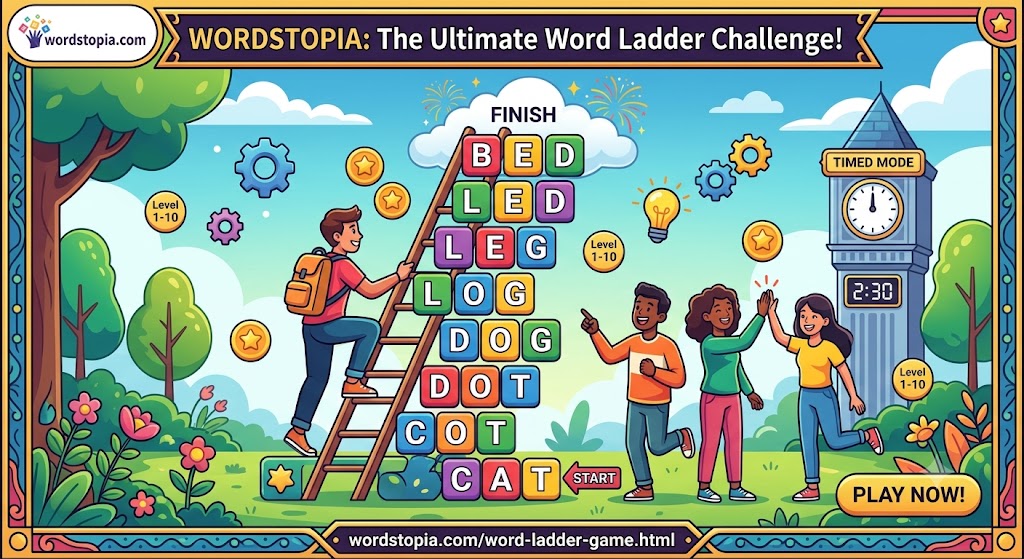
Wordstopia's free word ladder game — 10 difficulty levels, timed mode, clue system, and hundreds of word chain puzzles to solve online.
Famous Word Ladder Examples
Some word chain puzzles have become famous precisely because the transformation is so satisfying — the words at either end seem related, and the challenge is finding the elegant path between them. Here are the best-known examples:
- CAT → DOG (3 steps) The most famous word ladder of all. CAT → COT → DOT → DOG. Three steps, and every word is immediately recognisable — perfect for beginners.
- COLD → WARM (4 steps) COLD → CORD → WORD → WARD → WARM. A thematically satisfying word chain — turning cold into warm by passing through "cord" and "word."
- HEAD → TAIL (5 steps) Lewis Carroll's original Doublets challenge: HEAD → HEAL → TEAL → TELL → TALL → TAIL. The opposites transformation that started it all.
- LOVE → HATE (3 steps) LOVE → HAVE → HIVE → HIDE → HIDE... actually LOVE → LORE → GORE → GORE... This one is trickier than it looks! The shortest known path is LOVE → LONE → LANE → LAME → DAME → DIME → DINE → PINE → PANE → PATE → HATE — 10 steps.
- BLACK → WHITE (varies) A popular 5-letter word ladder challenge with many valid solutions. BLACK → SLACK → SLICK → SLICE → SPICE → SPINE → SWINE → SWIPE → SWIPE... routes vary depending on the vocabulary used.
How to Solve a Word Ladder — Strategy Tips
The word ladder game looks simple — just change one letter at a time — but finding the shortest path between two words is a genuine mental challenge. Here are the strategies that experienced word puzzle players use:
- Work from both ends simultaneously Start building a chain from the start word AND work backwards from the target word. When the two paths share a common bridge word, connect them. This "bidirectional" approach is how computer algorithms solve word ladders fastest, and it works just as well for human solvers.
- Identify which letters need to change Compare the start and end words letter by letter. Each position where they differ is a change you need to make. Focus on the letters that are farthest from their target positions first — these often drive the most steps.
- Use high-connectivity "hub" words Some words have many one-letter neighbours — words like BARE, CARE, DARE, FARE, HARE, MARE, PARE, RARE, WARE all differ by only one letter from each other. These "hub" words in the middle of a word chain give you the most routing options and let you change direction quickly.
- Change the hardest letter first If the start word has an uncommon letter (Q, X, Z, J) that needs to become a common one, make that swap as early as possible. Leaving difficult letter changes to the end often leads you into dead ends with no valid words available.
- Avoid dead ends — keep a mental list of tried words Word climbing puzzles have false paths. If you reach a word with very few valid neighbours, backtrack immediately. Keeping track of which words you have already used prevents circular routes.
Wordstopia's Free Online Word Ladder Game — Features
Wordstopia's word ladder game brings this classic word chain puzzle online with a full set of features for every skill level. Here is what you get:
Why Word Ladder Games Are Great for Your Brain
The word ladder game is more than just an entertaining brain teaser — it is a genuine vocabulary and cognitive workout. Here is why language teachers and cognitive researchers both love it:
- Vocabulary breadth To solve a word chain puzzle efficiently, you need to know a wide range of words — especially short, common words that have many one-letter neighbours. Regular play naturally expands the vocabulary you can access quickly under pressure.
- Pattern recognition Word ladder puzzles train your brain to see letter patterns and relationships between words — a skill that carries directly into spelling, reading comprehension, and language learning. Students who play word ladder games regularly tend to become faster readers.
- Planning and problem-solving Finding the shortest path between two words requires forward planning — mentally simulating future steps before committing to the current one. This kind of multi-step reasoning is exactly the cognitive skill that brain teaser puzzles are designed to strengthen.
- A screen break that still stimulates Unlike passive screen time, solving a word puzzle actively engages language, memory, and reasoning centres of the brain simultaneously. It is one of the few digital activities that genuinely counts as mental exercise.
More Word Games to Try on Wordstopia
If you enjoy the word ladder game, Wordstopia has a full library of free word games and vocabulary tools to explore:
Also Try on Wordstopia
Frequently Asked Questions
What is a word ladder game?
A word ladder game is a word puzzle where you transform one word into another by changing one letter at a time, with every intermediate step forming a valid English word. The goal is to reach the target word in as few steps as possible. Wordstopia's word ladder game is free to play online with 10 difficulty levels and timed mode.
Who invented the word ladder puzzle?
The word ladder puzzle was invented by Lewis Carroll — author of Alice's Adventures in Wonderland — in 1877. He called it "Doublets" and published puzzle challenges in Vanity Fair magazine from 1879 to 1881. His original rules (one letter change per step, only valid dictionary words) are still the standard rules used in word chain games today.
How do you solve a word ladder?
The most effective strategy is to work from both ends simultaneously — build a chain forward from the start word and backwards from the target word, then connect the two paths at a shared bridge word. Focus on changing the letters that are most different between the two words first, and use common short words with many one-letter neighbours to keep your routing options open.
What is the difference between a word ladder and a word chain?
They are the same puzzle with different names. A word ladder and a word chain both describe a sequence of words where each word differs from the previous by exactly one letter. "Word ladder" is the more common name today; "word chain" is also used, especially in educational contexts. Lewis Carroll's original name, "Doublets," is rarely used outside of historical references.
Is the word ladder game good for vocabulary building?
Yes — the word ladder game is one of the best vocabulary-building brain teasers available. Solving word chain puzzles efficiently requires knowing a wide range of common short words and their letter relationships, which naturally expands your accessible vocabulary over time. It also trains pattern recognition and spelling skills. Teachers regularly use word ladder puzzles in literacy and spelling lessons.