Word Families — The Complete Word Family List for Kids (Free Worksheets Included)
Word families are the single most powerful shortcut in early reading. Teach a child the -at pattern and they instantly know cat, bat, hat, mat, rat, sat, and flat — seven words for the price of one.
When children learn to read, they face a daunting task: English has over 170,000 words in common use. No child can memorise them all one by one. Word families solve this problem elegantly. By learning that words sharing the same ending pattern — the same "rime" — sound alike and behave alike, children can decode dozens of new words from a single lesson.
In this guide we explain exactly what word families are, why they are the fastest route to reading fluency, list the most important word family patterns for kindergarten and first grade, and point you to Wordstopia's free word families list and printable worksheets.
What Are Word Families?
A word family is a group of words that share the same ending pattern — the same vowel and consonant(s) at the end of the word, called a rime or phonogram. All the words in a family rhyme with each other and are spelled with the same ending chunk.
For example, the -at word family includes every word that ends in the letters A-T:
The key insight is this: once a child can read cat, they have everything they need to read bat, hat, mat, rat, and sat — because the only thing that changes is the first letter. Word families teach children to read in chunks rather than letter by letter, which is exactly how fluent adult readers process words.
📚 Research finding: A landmark study by Wylie and Durrell (1970) found that 37 common word family patterns account for 500 of the most frequently used words in early reading texts. Teaching these 37 families gives children access to roughly half of all the words they will encounter in their first two years of reading.
Why Word Families Are So Powerful for Early Reading
Reading specialists consistently rank word family instruction among the most effective strategies for building early literacy. Here is why:
- Pattern recognition over memorisation Memorising individual words is slow and effortful. Recognising a pattern — seeing -at and instantly knowing how to sound it — is fast and automatic. Word families shift children from slow letter-by-letter decoding to rapid pattern recognition, which is what reading fluency actually looks like.
- Multiplier effect on vocabulary Every word family pattern a child masters unlocks multiple new words at once. The -an word family alone covers can, fan, man, pan, ran, tan, van, ban, plan, scan, and span — 11 words from one pattern. Learning 20 families gives a child access to 200+ words.
- Reinforces rhyming and phonological awareness Word families are built on rhyme — all words in a family sound alike at the end. Practising rhyming words for kids through word families simultaneously develops phonological awareness, the ability to hear and manipulate the sounds in words, which is the strongest early predictor of reading success.
- Builds spelling intuition Children who learn word families do not just learn to read them — they learn to spell them. If you know that -ight words are spelled I-G-H-T, you can spell night, fight, right, light, might, sight, and tight without memorising each one individually.
- Builds reading confidence There is nothing more motivating for a young reader than successfully reading a word they have never seen before by applying a pattern they already know. Word family practice creates a constant stream of these "I can read it!" moments.
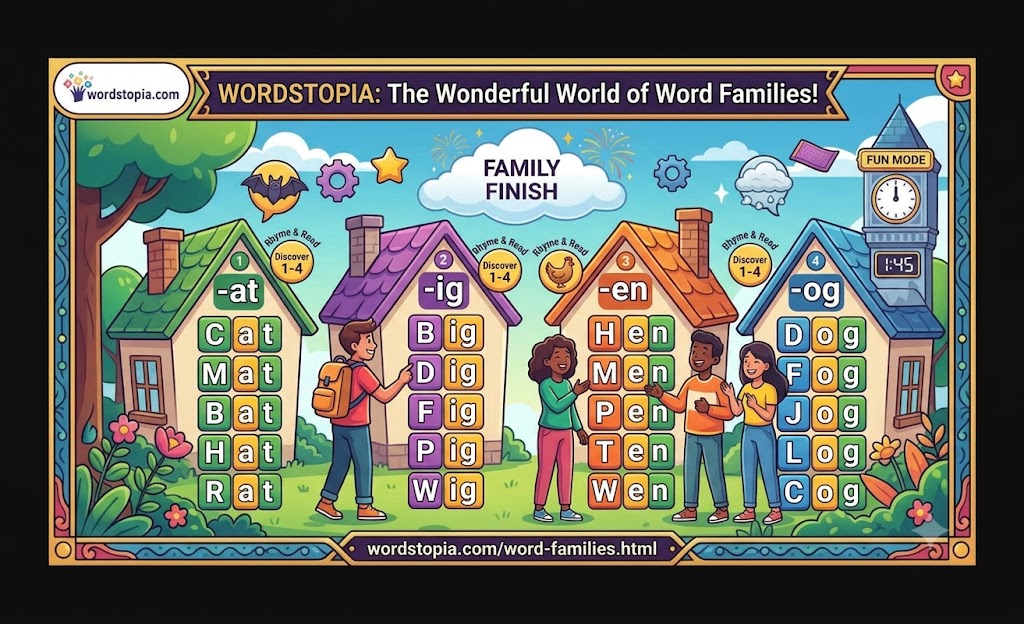
Wordstopia's word families page — explore 20+ word family patterns with example words, rhyming activities, and free printable worksheets for kids.
The Most Important Word Family List — 20+ Essential Patterns
Research identifies the word family patterns that appear most frequently in early reading texts. Here are the 20+ families that every beginning reader should learn, organised by vowel sound:
Short -a Families
Short -i Families
Short -o Families
Short -e Families
Short -u Families
Longer / Blended Families (First & Second Grade)
Word Families by Grade Level
Teachers and parents often ask: which word families for kids should be introduced at which age? Here is a general curriculum guide used by most phonics programmes:
| Grade / Age | Word Families to Focus On | Why These Families? |
|---|---|---|
| Pre-K / Age 4 | -at, -an, -ap | Simple 3-letter CVC words with the most common short-a sound; easy to read, write, and illustrate |
| Kindergarten / Age 5–6 | -at, -an, -ap, -ag, -ig, -it, -og, -op, -en, -ug, -un | All major short-vowel CVC families; covers the core 100+ words children encounter in early readers |
| First Grade / Age 6–7 | -ack, -ill, -ell, -all, -ight, -ake, -ame, -ing, -ink, -ank | Blended onset and longer patterns; introduces consonant blends and silent letters alongside the rime |
| Second Grade / Age 7–8 | -tion, -ment, -ness, -less, -ful, -ound, -ouse, -ould | Longer patterns and suffixes; bridges word family knowledge into morphology (understanding word parts) |
💡 Teacher tip: Introduce no more than one or two new word families per week. Spend several days reading, writing, sorting, and playing games with each new family before moving on. Depth of practice with fewer families produces stronger results than rushing through the whole list.
5 Fun Ways to Practise Word Families at Home
Word family practice does not have to mean worksheets. Here are five activities parents can do at home to make word families for kids engaging and memorable:
- Word family flip books Write the rime (-at, -ig, -op) on the right side of a small notebook. Write different onset letters (b, c, h, m, r, s) on individual flipping cards on the left. Kids flip through the letters, reading and saying each new word they make — a hands-on reading practice activity for ages 4–7.
- Word family houses Draw a house shape on a piece of paper and write the word family pattern on the roof (just like in Wordstopia's image above). Fill the "rooms" of the house with words that belong to the family. Kids can decorate each house and collect them into a "word family neighbourhood."
- Word family sorting games Write 20–30 words from 3 or 4 different families on individual cards. Mix them up and ask your child to sort them into piles by their ending sound. This reinforces the auditory pattern as well as the visual spelling — two pathways to the same knowledge.
- Rhyming read-alouds Choose picture books that are built around rhyme — Dr Seuss books are famously full of word family patterns (Cat in the Hat is essentially an extended -at and -ing family lesson). After reading, point out the rhyming pairs and ask your child to think of more words that sound the same.
- Online word family tools Wordstopia's word families page lets children explore all the major family patterns interactively, with example words and rhyming activities. It also includes free printable word family worksheets for each pattern — ready to download and use at home or in the classroom.
More Reading & Vocabulary Tools for Kids on Wordstopia
Also Try on Wordstopia
Frequently Asked Questions
What are word families?
Word families are groups of words that share the same ending pattern — the same vowel and final consonant(s). The -at word family includes cat, bat, hat, mat, rat, and sat. The -ig word family includes big, dig, fig, pig, and wig. All words in a family rhyme with each other and follow the same spelling pattern. Wordstopia's word families list covers 20+ patterns with example words and free worksheets.
What are the most common word families for beginning readers?
The 10 most important word families for kids starting to read are: -at, -an, -ig, -op, -ug, -en, -og, -it, -ap, and -un. These 10 families alone unlock over 100 common words found in early readers. After mastering these, the next tier includes -ack, -ight, -ake, -ame, -ill, -ell, -ing, -ink, and -ank.
What is the difference between word families and phonics?
Phonics teaches children to decode words by sounding out individual letters one at a time (c-a-t). Word families build on phonics by teaching children to recognise whole ending patterns (-at) and swap only the beginning consonant. Word families are faster and more efficient than letter-by-letter decoding — they are the bridge between basic phonics and true reading fluency. Most phonics programmes introduce word family patterns after children have learned the basic letter sounds.
Are word family worksheets helpful?
Yes — free word family worksheets are one of the most effective tools for consolidating word family knowledge. A good worksheet asks children to read words from the family, write them, sort them, and use them in sentences — multiple reinforcement modes in a single activity. Wordstopia's word families page includes free printable worksheets for all major patterns.
What grade level are word families taught?
Simple CVC word families (-at, -an, -ig) are introduced in pre-kindergarten and kindergarten (ages 4–6). More complex families involving consonant blends (-ack, -ight, -ack) are typically taught in first grade (ages 6–7). By second grade, children move on to longer suffix patterns (-tion, -ness, -ment) that build on their word family foundation.