What Is an Antonym? Meaning, Examples & How to Find Opposite Words
Antonyms are one of the most powerful vocabulary tools in English — once you understand them, expressing contrast and nuance becomes effortless.
If you have ever searched for the opposite of a word — whether for an essay, a crossword clue, or just out of curiosity — you have been looking for an antonym. But what is an antonym exactly, and why does understanding antonym meaning make you a stronger communicator?
In this guide, we will explain everything: the definition, the types, plenty of opposite words examples, and how to use Wordstopia's free antonym finder to look up opposites for any word in seconds.
Antonym Meaning — What Are Antonyms?
The antonym meaning is straightforward: an antonym is a word that has the opposite meaning to another word. The word itself comes from the Greek anti (against) + onoma (name), so it literally means "a name that goes against."
What are antonyms in practice? They are the word pairs that create contrast — the linguistic opposites that give language its range and richness. Without antonyms, we could not describe the full spectrum of human experience: light without dark, joy without sadness, fast without slow.
📖 Simple definition: An antonym is a word that means the opposite of another word. Hot and cold are antonyms. So are happy and sad, start and stop, and love and hate.
Everyday Antonym Examples
The best way to understand what are antonyms is to see them in action. Here are some of the most common opposite words pairs in everyday English:
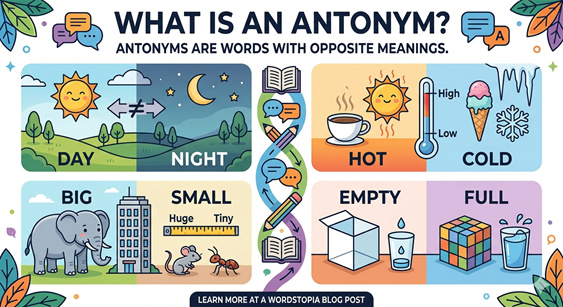
A visual guide to antonym meaning — opposite word pairs illustrated with everyday examples.
The Three Types of Antonyms
Not all opposite words work the same way. Linguists identify three main types of antonyms, and understanding the difference helps you use them more precisely in your writing and communication.
| Type | What it means | Examples |
|---|---|---|
| Gradable antonyms | Opposites on a scale — something can be in between | hot / cold, tall / short, fast / slow, rich / poor |
| Complementary antonyms | Binary opposites — one or the other, no middle ground | alive / dead, true / false, on / off, pass / fail |
| Relational antonyms | Pairs that only make sense in relation to each other | teacher / student, buy / sell, parent / child, give / receive |
💡 Did you know? The word "lukewarm" exists precisely because hot and cold are gradable antonyms — there is a whole spectrum of temperature between them. Complementary antonyms like alive and dead have no such middle ground.

Antonyms are taught early in English education because understanding opposite words builds vocabulary rapidly.
Why Antonyms Matter for Your Writing
Knowing what is an antonym is not just a grammar exercise — it is a practical writing skill. Strong writers use antonyms constantly to:
- Create contrast and tension Placing opposite words side by side — "It was the best of times, it was the worst of times" — is one of the most powerful rhetorical devices in literature.
- Avoid word repetition Instead of writing "not happy," use the antonym "sad" or "miserable." Knowing the right antonym makes your writing tighter and more precise.
- Expand vocabulary Learning words in antonym pairs — brave/cowardly, generous/stingy, loud/quiet — doubles your vocabulary gains. Every new word brings its opposite along for free.
- Improve persuasive writing Antonyms let you frame arguments powerfully: "This policy promotes freedom, not restriction. It builds unity, not division."
- Help ESL learners Learning opposite words in pairs is one of the most effective techniques for building English vocabulary quickly and memorably.
How to Use the Wordstopia Antonym Finder
Wordstopia's antonym finder makes it instant and effortless to look up opposite words for any term. Here is how it works:
- Type any word Enter a word into the search box — a verb, noun, adjective, or adverb — and the tool returns its antonyms immediately, grouped by part of speech.
- Browse opposites by category Results are organised so you can quickly find the antonym that fits the context — whether you need a formal opposite for academic writing or a conversational one for everyday use.
- Explore related words Alongside antonyms, you can jump straight to synonyms, definitions, example sentences, and word forms — all in one place.
- No account needed The antonym finder is completely free with no sign-up required. Visit wordstopia.com/antonyms and start searching straight away.

Writers, students, and language learners all benefit from having a reliable antonym finder at hand.
Antonyms vs Synonyms — What Is the Difference?
A question that often comes up alongside "what is an antonym" is how it differs from a synonym. The distinction is simple:
A synonym is a word with a similar meaning — happy, joyful, glad, cheerful are all synonyms. An antonym is a word with the opposite meaning — sad, unhappy, miserable are antonyms of happy.
🔗 Related tools: Use the Antonym Finder when you need contrast, and the Synonym Finder when you need variety. Together they cover the full vocabulary spectrum for any word.
Common Antonym Examples by Category
Adjective antonyms
bright / dark • brave / cowardly • clean / dirty • easy / difficult • generous / stingy • honest / dishonest • kind / cruel • loud / quiet • safe / dangerous • wise / foolish
Verb antonyms
accept / reject • add / subtract • arrive / depart • attack / defend • build / destroy • buy / sell • expand / contract • forget / remember • love / hate • push / pull
Noun antonyms
beginning / end • enemy / friend • failure / success • hero / villain • peace / war • pleasure / pain • poverty / wealth • problem / solution • question / answer • victory / defeat
Frequently Asked Questions About Antonyms
What is an antonym in simple terms?
An antonym is a word that means the opposite of another word. For example, the antonym of "hot" is "cold," and the antonym of "happy" is "sad." Antonyms always come in pairs of opposite words.
What are antonyms used for?
Antonyms are used to express contrast, avoid repetition, add variety to writing, and make descriptions more precise. They are also widely used in vocabulary teaching, crossword puzzles, and word games.
Can a word have more than one antonym?
Yes. Many words have multiple antonyms depending on context. The antonym of "light" could be "dark" (describing colour), "heavy" (describing weight), or "serious" (describing mood). A good antonym finder will show you all the options.
What is the difference between an antonym and an opposite?
"Opposite words" and "antonyms" are essentially the same thing — just different ways of describing the same concept. "Antonym" is the technical linguistic term, while "opposite word" is the everyday description.
How do I find the antonym of a word quickly?
The fastest way is to use Wordstopia's free antonym finder. Type any word and instantly see its opposite words, grouped by part of speech, with no sign-up needed.
Are antonyms always single words?
Usually yes, but sometimes the opposite of a concept requires a phrase. For example, "the antonym of justice" could be "injustice" (one word) or "lack of fairness" (a phrase). English typically has single-word antonyms for most common adjectives and verbs.