What Is a Synonym? Meaning, Examples & How to Find Them in English
Synonyms are the secret weapon of great writers — they add variety, precision, and life to your language without changing what you mean.
If you have ever looked for a more interesting way to say something, or wanted to avoid repeating the same word twice in a sentence, you have been searching for a synonym. But what is a synonym exactly, and why does understanding synonyms meaning make such a difference to the quality of your writing and communication?
In this guide, we cover everything: the definition, how to spot and use them, plenty of interesting synonyms in English, and how to use Wordstopia's free synonym finder to look up alternatives for any word instantly.
Synonyms Meaning — What Is a Synonym?
The word synonym comes from the Greek syn (same) + onoma (name), which literally means "same name." In practice, a synonym is a word that has the same — or very similar — meaning to another word in the same language.
So what is a synonym in everyday terms? It is simply a word you can swap in for another without significantly changing what you are saying. Happy and joyful are synonyms. So are fast and quick, big and large, and gift and present.
📖 Simple definition: A synonym is a word with the same or similar meaning as another word. Happy, joyful, cheerful, and glad are all synonyms — they all describe the same feeling, just with slightly different flavours.
Everyday Synonym Examples
The best way to understand synonyms meaning is to see them in action. Here are some of the most common synonym groups in synonyms English usage:
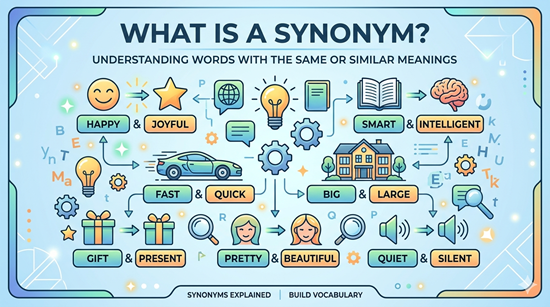
A visual guide to synonyms meaning — words that share the same or very similar meanings in English.
Are Synonyms Exactly the Same?
This is one of the most important things to understand about synonyms meaning: true perfect synonyms — words that are completely identical in every context — are very rare in English. Most synonyms are near-synonyms: they overlap significantly in meaning but carry slightly different nuances, formality levels, or emotional tones.
For example, happy, joyful, elated, and content are all synonyms, but they feel different. Elated suggests intense excitement, while content implies quiet satisfaction. Choosing the right synonym is not just about finding a different synonym — it is about finding the word that fits the mood and context precisely.
💡 Did you know? English has more synonyms than almost any other language, largely because it has absorbed words from Latin, French, Norse, and German. That is why we have pairs like kingly (Old English) and royal (French), or begin (Old English) and commence (Latin) — they mean the same thing but feel different in tone.

Reading widely is one of the best ways to naturally encounter synonyms in English and expand your vocabulary.
Interesting Synonyms in English
One of the most enjoyable parts of exploring synonyms English has to offer is discovering the more unusual, vivid, or literary alternatives that exist for everyday words. Here is a table of some interesting synonyms that will add real colour to your writing:
| Everyday Word | Interesting Synonyms | Best used when… |
|---|---|---|
| Angry | furious, incensed, livid, irate, indignant | You want to show the intensity of the emotion |
| Walk | saunter, amble, trudge, stride, meander | You want to show how someone walks, not just that they walk |
| Look | gaze, glance, peer, scrutinise, observe | You want to convey the manner or purpose of looking |
| Said | whispered, proclaimed, murmured, insisted, mused | Writing dialogue and want to avoid repeating "said" |
| Good | excellent, superb, exceptional, commendable, admirable | You need a more formal or emphatic alternative |
| Old | ancient, aged, antique, venerable, time-worn | Describing something with history or dignity |
| Tired | exhausted, weary, fatigued, drained, spent | Showing the degree of tiredness matters |
| Small | tiny, minute, petite, compact, diminutive | You want a specific shade of smallness |
Why Synonyms Matter for Writing and Communication
Understanding what is a synonym is not just a grammar lesson — it is a core writing skill. Here is why synonyms are so valuable:
- Avoid repetition Using the same word twice in a paragraph feels clumsy. A different synonym keeps the prose flowing without changing your meaning. Instead of "the big house had a big garden," try "the large house had an expansive garden."
- Match the tone and register Synonyms English offers range from very casual to highly formal. Start is casual; commence is formal; initiate is technical. Choosing the right one signals your awareness of context.
- Add precision and nuance Not all interesting synonyms mean exactly the same thing. Slim, slender, thin, and gaunt all relate to body shape but carry very different connotations. The right synonym says exactly what you mean.
- Make writing more vivid Strong verbs and specific synonyms paint pictures. Instead of "he walked slowly," try "he trudged" or "he shuffled." The synonym does the work of an adverb, making writing tighter and more powerful.
- Boost vocabulary fast Learning words in synonym groups is one of the most efficient vocabulary strategies. Every time you learn a new synonym, you expand the range of ideas you can express precisely.
How to Use the Wordstopia Synonym Finder
Wordstopia's synonym finder makes it effortless to discover words with the same or similar meanings for any word in English. Here is how it works:
- Type any word Enter any noun, verb, adjective, or adverb into the search box and the tool returns synonyms instantly — grouped by part of speech so you always find the right grammatical match.
- Explore multiple meanings Many words have more than one meaning, and each meaning has its own set of synonyms. The tool shows them all, so you can pick the one that fits your context.
- Jump to definitions and examples Click any synonym to see its full definition, pronunciation, and example sentences — helping you confirm it is exactly the right word before you use it.
- No account, no cost The synonym finder is completely free with no sign-up. Just visit wordstopia.com/synonyms and start searching instantly.
Great writers rely on synonyms to bring precision and variety to their work — and a good synonym finder makes it effortless.
Synonyms by Category — Quick Reference
Synonyms for "said" (for writers)
Synonyms for "good"
Synonyms for "happy"
Synonyms for "important"
🔗 Related tools on Wordstopia: Pair the Synonym Finder with the Antonym Finder to see both the similar and opposite words for any term. Use Another Word For for quick conversational alternatives.
Frequently Asked Questions About Synonyms
What is a synonym in simple terms?
A synonym is a word that means the same or nearly the same as another word. For example, big and large are synonyms, and happy and joyful are synonyms. They can often be swapped in a sentence without changing the overall meaning.
What is the synonyms meaning exactly?
The synonyms meaning is that these are words sharing the same or very similar meaning. The word comes from Greek: syn (same) + onoma (name). A synonym group is a set of words that all point to the same idea, concept, or quality.
Are all synonyms exactly the same?
Not quite. True perfect synonyms are rare. Most synonyms have subtle differences in tone, intensity, or formality. For example, tired and exhausted are synonyms, but exhausted is more extreme. Choosing the right synonym is about finding the best fit for your context.
Why are there so many interesting synonyms in English?
English has borrowed heavily from Latin, French, Old Norse, and German over centuries, which is why it has such an unusually rich collection of interesting synonyms. Many synonym pairs exist because one word came from Old English and another from French — like begin and commence, or buy and purchase.
What is a different synonym for a common word like "good"?
There are many different synonym options for "good" depending on context: excellent, superb, admirable, fine, great, outstanding, and splendid are all possibilities. Use Wordstopia's synonym finder to see the full list for any word.
How do I find synonyms quickly?
The fastest way is Wordstopia's free synonym finder. Type any word and instantly see all its synonyms grouped by meaning and part of speech — no account needed, no cost.