
Tips & Tricks to Solve All Word Search Puzzles
Become a word search master with these proven strategies!
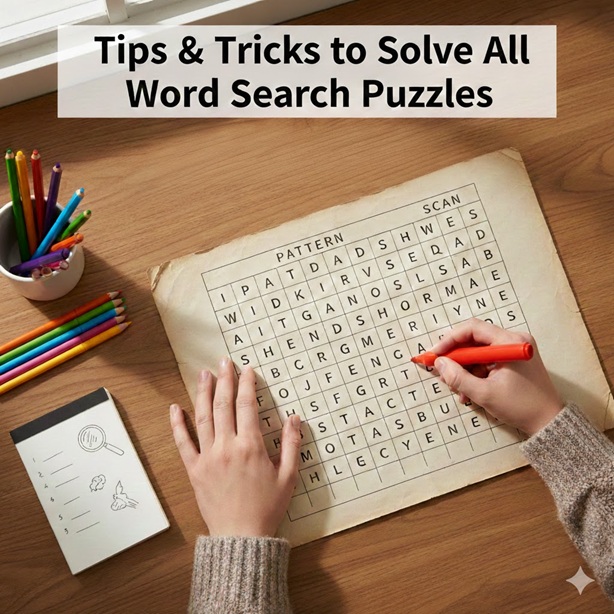
Word search puzzles are a beloved pastime enjoyed by millions around the world. Whether you're solving them on a lazy Sunday afternoon, during a commute, or as a mental workout, these puzzles offer endless entertainment while sharpening your observation skills. But if you've ever stared at a grid of letters feeling completely overwhelmed, you're not alone. The good news is that with the right techniques, you can become a word search solving expert in no time.
1. Scan the Word List First
Before diving into the grid, take a moment to review the entire word list. Familiarize yourself with what you're looking for. Pay special attention to longer words and words with unusual letter combinations—these are often easier to spot in the grid because they stand out more from random letter sequences.
Some solvers find it helpful to mentally note words that start with less common letters like Q, X, Z, or J. These letters appear less frequently in the grid, making words containing them easier to locate quickly.
2. Look for the First Letter
Once you've selected a word to find, scan the entire grid systematically for its first letter. When you spot it, check all eight directions from that letter: up, down, left, right, and all four diagonals. If the second letter matches in any direction, continue following that path to see if the complete word appears.
This methodical approach is far more effective than randomly scanning the grid hoping to stumble upon complete words. It gives your search structure and dramatically reduces the time needed to locate each word.
3. Search in All Directions
Remember that words in word search puzzles can run in eight different directions: horizontally (left to right or right to left), vertically (top to bottom or bottom to top), and diagonally (in all four diagonal directions). Many puzzlers forget to check for backwards words, which can cause frustration when a word seems impossible to find.
Train yourself to automatically check every direction. With practice, this becomes second nature, and you'll find words that previously seemed invisible.
4. Circle or Cross Out Found Words
Always mark the words you've found in the grid—whether by circling, highlighting, or drawing a line through them. Equally important is crossing off words from your list as you find them. This prevents you from wasting time searching for words you've already located and helps you track your progress.
Using different colors for different words can make your completed puzzle more visually satisfying and easier to review if you need to verify your solutions.
5. Focus on Uncommon Letter Patterns
Certain letter combinations are relatively rare in English and stand out in a sea of common letters. Look for double letters (like "LL," "SS," or "EE"), unusual consonant clusters (like "PH," "GH," or "TH"), or distinctive endings (like "-ING," "-TION," or "-LY"). These patterns act as visual anchors that can help you quickly locate words.
For example, if you're searching for "ELEPHANT," the "PH" combination is much rarer than individual letters like E or A, so scanning for that specific pattern will speed up your search considerably.
6. Work Systematically Through the Grid
Instead of letting your eyes wander randomly, develop a systematic scanning pattern. Some solvers prefer to work row by row from top to bottom, while others prefer column by column. You might also try scanning diagonally or working from the outside edges toward the center.
The specific pattern matters less than being consistent. A systematic approach ensures you examine every part of the grid and don't overlook words hiding in areas you thought you'd already checked.
7. Take Breaks When Stuck
If you're struggling to find the last few words, step away from the puzzle for a few minutes. Your brain continues processing visual information subconsciously, and when you return with fresh eyes, words that seemed invisible before often jump out immediately. This phenomenon, sometimes called the "incubation effect," is well-documented in problem-solving research.
A short break can be more productive than stubbornly staring at the same grid for extended periods.
8. Practice Peripheral Vision
Experienced word search solvers develop strong peripheral vision skills. Instead of focusing narrowly on one letter at a time, try to take in larger sections of the grid simultaneously. With practice, you can train your eyes to recognize word patterns even when they're not in your direct line of sight.
This skill develops naturally with regular practice and significantly speeds up solving times as you become more experienced.
9. Start with the Longest Words
Longer words are generally easier to find because they have more letters to match and fewer possible positions in the grid where they can fit. Starting with the longest words on your list builds momentum and confidence while eliminating large sections of potential confusion.
Once you've found the longer words, the remaining shorter words often become easier to spot in the less cluttered visual field.
10. Enjoy the Process
Finally, remember that word search puzzles are meant to be enjoyable! Don't put pressure on yourself to solve them quickly. The mental benefits—improved focus, vocabulary reinforcement, and relaxation—come from the process itself, not just from completion. Take your time, appreciate the small victories of finding each word, and celebrate when you complete a puzzle.
Ready to Practice?
Try our free Word Search Puzzle game! Choose from multiple themes and difficulty levels to put your new skills to the test.