
Sudoku Proven Strategies Can Solve Almost Any Sudoku
Unlock the Logic, Conquer the Grid!
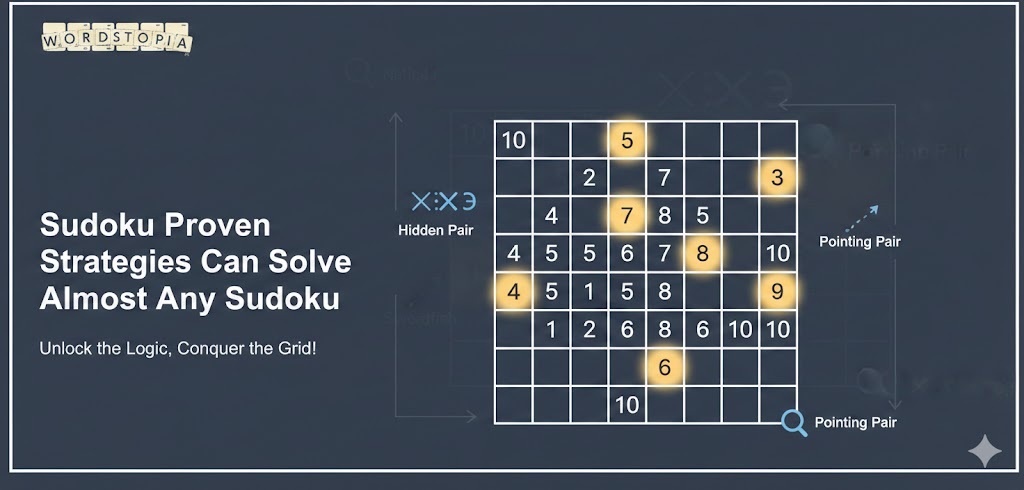
Sudoku has captivated puzzle enthusiasts worldwide with its elegant simplicity and satisfying logical challenges. While the rules are straightforward—fill a 9x9 grid so that each row, column, and 3x3 box contains the digits 1-9 exactly once—mastering the game requires learning proven strategies that go beyond simple trial and error. Whether you're a beginner struggling with medium-difficulty puzzles or an experienced solver looking to tackle expert-level grids, these time-tested techniques will transform your Sudoku skills.
1. Scanning: The Foundation of Every Solve
Before diving into advanced techniques, every Sudoku solver must master the art of scanning. This fundamental strategy involves systematically examining rows, columns, and boxes to identify where specific numbers can and cannot be placed. Start by looking for numbers that appear frequently in the given clues, then scan each row and column to find cells where only one possibility remains.
Horizontal and vertical scanning work together beautifully. When you find a number in two rows within a 3x3 box, the third row in that box can only contain that number in the remaining empty cells. This cross-referencing technique, sometimes called "cross-hatching," is the backbone of Sudoku solving and can often solve easy to medium puzzles entirely on its own.
2. Pencil Marking: Track Your Candidates
As puzzles become more challenging, keeping mental notes becomes impossible. Pencil marking—writing small candidate numbers in cells—allows you to track all possibilities systematically. For each empty cell, note which numbers from 1-9 are still valid based on the row, column, and box constraints.
While this might seem tedious at first, pencil marking reveals patterns invisible to the naked eye. Once you've marked candidates throughout the grid, advanced strategies like hidden pairs and pointing pairs become much easier to spot. Many experienced solvers consider this step essential for any puzzle rated medium difficulty or higher.
3. Hidden Singles: The First Step Beyond Basics
A hidden single occurs when a cell is the only place in a row, column, or box where a specific number can go, even though that cell might have multiple candidate numbers. Unlike "naked singles" (cells with only one candidate), hidden singles require examining the entire unit to discover them.
For example, if you're looking at a row where the number 7 can potentially go in three different cells, but two of those cells are eliminated by 7s in their respective columns, the remaining cell must contain the 7—even if it has other candidates listed. This technique catches many placements that pure scanning misses.
4. Naked Pairs and Hidden Pairs
When two cells in the same row, column, or box contain exactly the same two candidate numbers and only those two numbers, you've found a naked pair. Since those two numbers must occupy those two cells, you can eliminate them as candidates from all other cells in that unit. This often triggers a cascade of additional eliminations and placements.
Hidden pairs are trickier to spot. They occur when two numbers appear as candidates in only two cells within a unit, even if those cells contain other candidates. Once identified, you can remove all other candidates from those two cells, effectively converting your hidden pair into a naked pair. This technique extends to triples and quads, though pairs are most common.
5. Pointing Pairs: Box-Line Reduction
Pointing pairs occur when a candidate number within a 3x3 box is restricted to a single row or column. When this happens, that number can be eliminated from that row or column outside the box. The logic is simple: since the number must appear somewhere in those specific cells within the box, it cannot appear elsewhere in that row or column.
This technique works in reverse too, called "box-line reduction" or "claiming." If a number in a row or column is confined to cells within a single box, you can eliminate that number from other cells in that box. Pointing pairs often unlock previously stuck puzzles by eliminating seemingly valid candidates.
6. X-Wing: Pattern Recognition Mastery
The X-Wing technique represents a significant step up in Sudoku strategy. It occurs when a candidate number appears in exactly two cells in two different rows, and those cells align in the same two columns (or vice versa). The four cells form a rectangle or "X" pattern.
When you find an X-Wing, the candidate number can be eliminated from all other cells in the two columns (or rows) involved. This is because the number must appear in exactly two of the four corner cells—either the top-left and bottom-right, or the top-right and bottom-left. Either way, the candidate is eliminated from other cells in those lines. X-Wing patterns are rare but incredibly powerful when they appear.
7. Swordfish and Beyond
For those ready to tackle the most challenging puzzles, Swordfish extends the X-Wing concept to three rows and columns. When a candidate appears in two or three cells in three rows, and these cells collectively occupy exactly three columns, all other occurrences of that candidate in those columns can be eliminated.
Even more advanced techniques like Jellyfish (four rows/columns), XY-Wing, and forcing chains exist for the most diabolical puzzles. However, the strategies covered above—scanning, pencil marking, hidden singles, pairs, pointing pairs, and X-Wing—are sufficient to solve the vast majority of published Sudoku puzzles, including many rated as "expert" or "extreme."
Practice Makes Perfect
Learning these strategies is just the beginning. True mastery comes from applying them repeatedly until pattern recognition becomes second nature. Start by consciously practicing each technique on appropriate difficulty levels, then gradually combine them as you tackle harder puzzles.
Remember that Sudoku should never require guessing. Every puzzle designed by reputable publishers has a logical solution path using the techniques described above. If you find yourself wanting to guess, take a step back and look for patterns you might have missed. With practice and patience, you'll be solving puzzles that once seemed impossible.
Ready to Practice?
Put these strategies to the test with our free Sudoku Online game! Choose from Easy, Medium, or Hard difficulty levels and start solving today.